
Hello, policy enthusiasts!
Here’s a set of numbers for you to think about: 39.5% and 25.9%.
With a difference of 13.6 percentage points, these numbers represent an interesting finding in India’s latest labour market data.
On 16 November 2026, the Ministry of Statistics and Programme Implementation released the October edition of the Periodic Labour Force Survey (PLFS), bringing this rural–urban contrast in women’s Labour Force Participation Rate (LFPR) into focus. However, behind these numbers lie larger questions about the nature of women’s work, access to employment and the barriers that continue to shape their participation.
So, in this edition, we’re taking a closer look at this rural–urban divide, alongside a fresh roundup of opportunities, events and calls for papers, developments in the Canada-India corridor through the Maple Bridge Project, and updates from the PPI community.
Settle in, grab your chai, and let’s get reading!

💼 Five Opportunities Worth Applying to:
1. Policy and Research Associate – All India Disaster Mitigation Institute (AIDMI)
Location: Ahmedabad, Gujarat
Deadline: 20 November 2026
Who should apply: Candidates with a Master’s degree and 1–3 years of experience in policy research, development consulting or programme evaluation.
2. Junior Program Associate – Freight, WRI India
Location: New Delhi, Delhi
Deadline: 23 November 2026
Who should apply: Early-career professionals interested in transport policy, sustainable mobility, climate action and urban development.
Explore opportunity & apply here
3. Associate – Communications, Vidhi Centre for Legal Policy
Location: New Delhi, Delhi
Deadline: 29 November 2026
Who should apply: Candidates interested in strategic communications, content development and public engagement, preferably with experience in research or nonprofit organisations.
Explore opportunity & apply here
4. Associate / Junior Associate – Jeevika Project, Centre for Civil Society
Location: New Delhi, Delhi & Jaipur, Rajasthan
Deadline: 30 November 2026
Who should apply: Fresh graduates and early-career professionals interested in livelihoods, community mobilisation, financial inclusion and grassroots development.
Explore opportunity & apply here
5. Winter Internship Programme 2026–27 – Centre for Development Policy and Practice (CDPP)
Location: Hyderabad, Telangana
Deadline: 20 November 2026
Who should apply: Undergraduate and postgraduate students in economics, public policy, social sciences, law and related disciplines.
Looking for more? Explore the PPI Career Database for internships, fellowships, scholarships and job opportunities.

💬 Policy Charcha: One Thing to Learn This Week!
Is India’s female workforce story more rural than urban?
The October 2026 PLFS figures put rural women’s Labour Force Participation Rate (LFPR) at 39.5%, against 25.9% in urban India. At first glance, this suggests that more women are participating in rural areas. But the numbers tell only part of the story. The bigger question is whether this participation is translating into better work and greater economic independence.
A closer look at the employment data reveals why this distinction matters. The Ministry of Finance’s April 2026 review of Annual PLFS 2025 found that only 9.3% of rural women workers were in regular wage or salaried employment. Many others were self-employed or worked as helpers in household enterprises. Their work counts towards participation, but it may not guarantee a regular income or financial security.
The urban employment puzzle
The lower urban participation rate points to a different set of challenges. While cities offer a wider range of jobs, women may still struggle to access them. Two findings are particularly worth noting:
The Economic Survey 2025–26 highlights the role of safe transport and last-mile connectivity
While a March 2026 UNFPA analysis points to an education–employment gap: women with intermediate levels of education participate less than those at the lower and higher ends of the education spectrum.
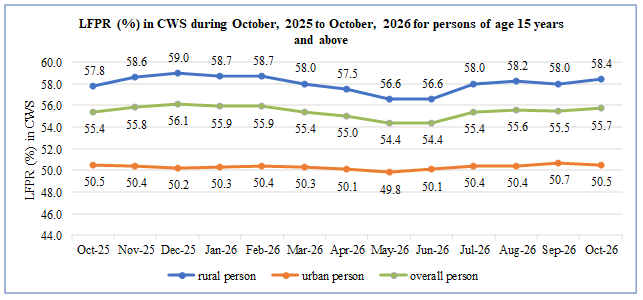
Image sourced from Press Information Bureau (PIB)
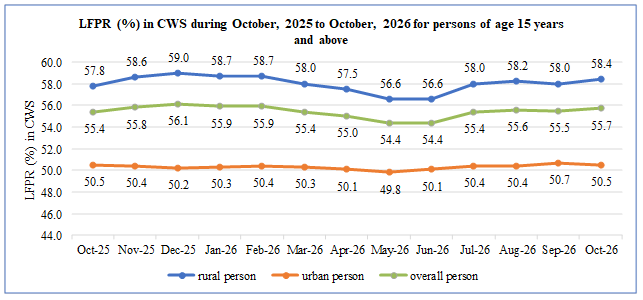
So, the rural–urban divide is not simply about where more women work. It is about the different barriers that shape the work available to them.
Where should policy focus?
The conversation needs to move beyond participation targets and towards the quality and accessibility of work. Some priorities stand out:
Measure job quality: Track regular wages, social security and opportunities for career progression, not just workforce entry.
Make cities work for women: Treat safe transport, last-mile connectivity and affordable housing near employment centres as part of employment policy.
Bridge the care and employment gap: Expand accessible workplace childcare and make care infrastructure part of economic planning.
Want to understand the bigger picture?
🎥 Watch Understanding Trends in Women’s Employment in India, featuring economist Rosa Abraham, for a closer look at how women’s employment in India is changing and what the numbers reveal.

📅 Events and Call for Papers
1. International Research Conference: Beyond the Text – Reimagining International Trade through a Gendered Lens
Chanakya National Law University (CNLU), Patna, in collaboration with the Centre for Trade and Investment Law (CTIL), IIFT, is organising a research conference examining how international trade rules and global value chains intersect with gender equality.
Dates: 15–16 December 2026
Venue: CNLU, Patna, Bihar
Read the official call for papers
2. India Public Policy Education Conference (IPPEC) 2026
A two-day gathering bringing together policy schools, think tanks, researchers, practitioners and students to discuss the future of public policy education in India, including the role of AI, curriculum design and the skills needed by policy professionals.
Date: 7–8 December 2026
Venue: CHRIST University, Bengaluru, Karnataka
3. National Seminar: Cooperatives and Viksit Bharat 2047 – Centre for Economic and Social Studies (CESS)
CESS invites original research on cooperatives and their role in inclusive growth, rural transformation, social justice, agriculture and community development.
Date: 21–22 December 2026
Venue: Hyderabad, Telangana
Full paper deadline: 28 November 2026
Who can submit: Researchers and scholars working on cooperatives, rural development, agriculture and social inclusion.
Read the official call for papers
Click here to explore more events:

🇨🇦 Canada Corner | The Maple Bridge Project
1. Planning to study in Canada? Know what the revised funds requirement means for Indian students
For study permit applications submitted on or after 1st September 2026, a single applicant studying outside Quebec must now show proof of C$23, 448 to cover first year living expenses, C$553 more than before. The updated requirement is part of Canada’s annual adjustment to its cost-of-living benchmark.

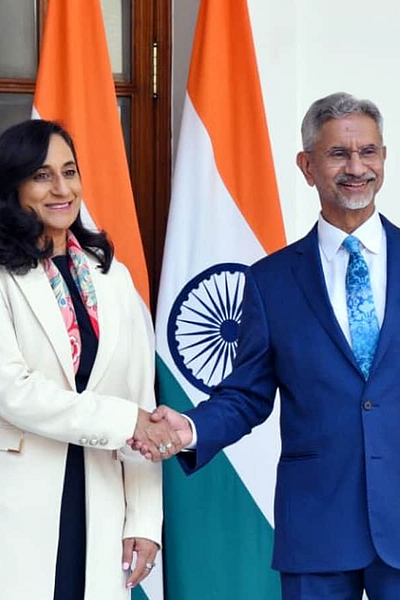
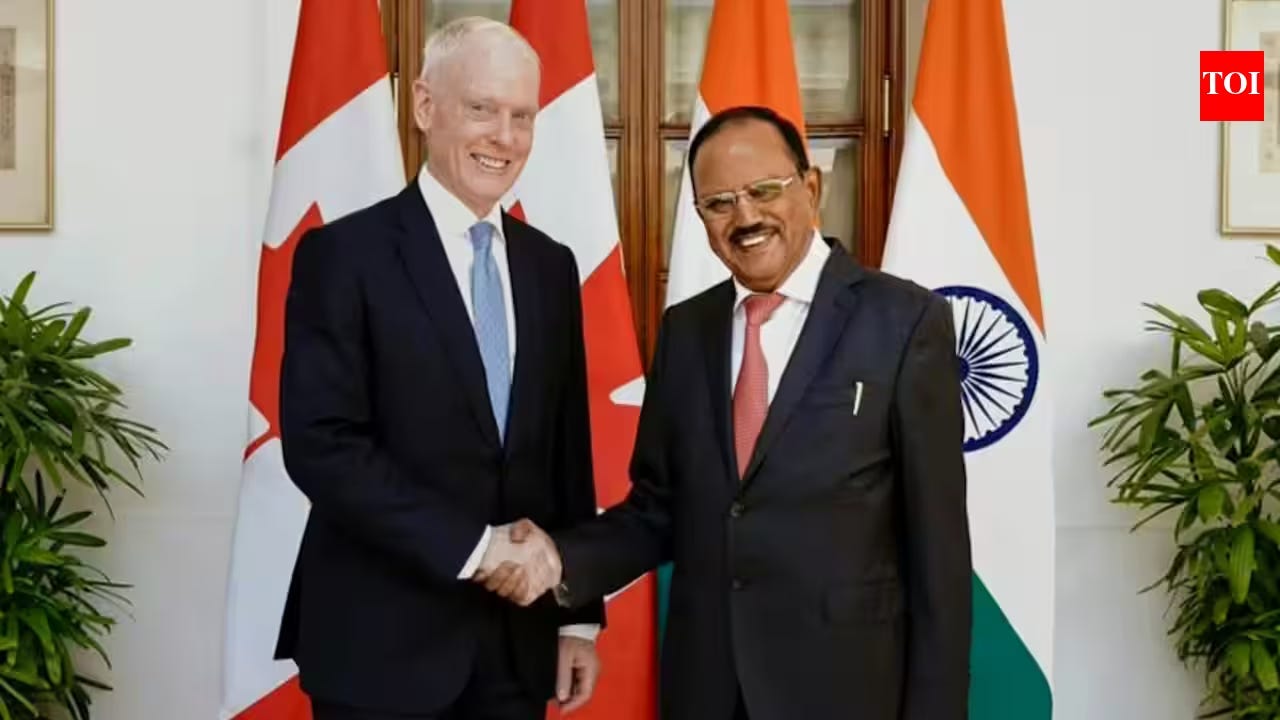
2. India–Canada security cooperation: Building a more structured partnership
The third round of India–Canada NSA-level Security Dialogue, held in New Delhi from 5–7 October 2026, focused on strengthening cooperation on transnational crime, cybersecurity, trafficking and information-sharing.
🌷PPI Referral Program: Help us grow our community
Thank you for taking the time to read The Policy Post this week. If you find what we do at PPI to be of value, please spread the word.
Make sure to use the above link while referring for automatic rewards upon referrals! :D
See you next week!!